Thursday, July 7, 2011

The Time We All Lived in a Yellow Submarine

Sandbars ruled the route of the raft down the Savannah River. They directed the way around a bend. They were hazards to avoid lest the raft run aground. They provided a diving board for campers during a lunch stop. And they accorded soft rest for ten campers, Chief Bob, and me while all of us slept in tents pitched on them.

Yellow Submarine 3 Wayne Shackelford

Pontoons technically kept the craft from being one, but the ten boys of Chimpta Group from Camp E-ku-Summee on the Uwharrie National Forest near Candor, North Carolina insisted on calling it the “Yellow Submarine,” and painted it a  bright yellow with a toothy, impudent smile on its front. I suppose their giddy excitement at the prospect of floating for twenty eight days on it down the border between South Carolina and Georgia is what suspended more careful christening.

Why not paddle canoes, the usual therapeutic maneuver marshaled by the managers of the Eckerd wilderness camping program? Well, “it’s in the field manual” to use the words of Tom Hank’s character in Saving Private Ryan.

That manual would be the bible, of sorts, called Wilderness Road, published in 1965 by Campbell Loughmiller of the Dallas, Texas Salesmanship Club. Director of Camp Woodland Springs, the Club’s primary beneficiary, he had tinkered for twenty years by then with using camping as the tool toward rehabilitating kids with emotional problems. There’s a chapter about rafting down the Red River and then down the Mississippi to New Orleans. I looked it up recently.

From an academic point of view, perhaps the most pertinent undertaking for the trip was an intensive study of the Savannah River watershed. Map study and social studies provided the main focus. Putting in had to be below the “fall line” off the Piedmont Plateau before which much of the river had been stopped by dams. Serving then as one long spill way, the route from there to the city from which it derives its name was narrow, yet deep enough for big boats, including tugs pushing barges. We marveled one time in camp inspecting how the river captain of one such tug nimbly finessed its lumbering push toy around the narrow bend on which our campsite lay.

Yellow Submarine 2 Tommy Walton

Using no power, just floating like Huck Finn’s, Yellow Submarine had no use for a rudder. So one of the academic questions in the preparation was how a sweep oar would be used for steering. Then there were measurement exercises of all kinds, from coinciding cabinet dimensions with equipment volumes, and loading weight with pontoon buoyancy specifications. I remember dissuading the menu crew from an inordinate reliance on breakfasts consisting of hominy grits with Cheese Whiz stirred in. Though never described using the term, “school” continued on board with lessons in art, botany, reading, and journal writing.

Yellow Submarine 1

The boys had to calibrate river speed with channel length in order to gauge where to put in and take out according to allotted time of travel. The Savannah River turned out to be a rather fast-flowing stream. I proved that one day when swimming free, no PFD, so I could scull down to the river bottom. The river bottom whipped along handily underneath my feet. We easily reached the city of Savannah with time for layovers, I remember.

Yellow Submarine 4 Allen Watson, Robert House

If one word summarized the feel of the trip, that word is gritty. Sand got into everything. Campsite cleaning became grit removal mostly. And if one paragraph summarized the meaning of the trip, that paragraph is found in Campbell’s book in the chapter RAFT TRIPS.

“If the raft belonged to the boys when they weighed anchor at Denison, Texas, it belonged to them now in a deeper sense. It had acquired a spiritual quality. It had been so intimately and vitally a part of their lives for these many weeks that they had regarded it almost with affection.”

Saturday, June 11, 2011

Woodsy Domicile: Forest Gardening and The Elusive Return to Eden

Woodsy Domicile 3 Crane Rd 8-98
 
Home ownership holds a mythical place in the American experience, alongside no taxation without representation, Paul Bunyan, Ichabod Crane, motherhood, and apple pie. It’s the foundation of the “American Dream.” A science teacher mostly having worked in low-paying private schools, I was fortunate enough to satisfy strict criteria governing this critical piece in our capitalist economy only once in my working life. It was in the late nineteen nineties when, for about five years, I lived in a ranch house on an acre and a half of oak woodland in NE Illinois. This is a story of how the opportunity to live in this “woodsy domicile” was more than just an escape from the world of rentals ruled by landlords.
 
Sprawl
 
The county was once dominated by an oak savannah “prairie” landscape that, historically, was plowed into corn fields. And by the present time, “Chicagoland” sprawl had come knocking, rather more like pounding, on the county’s door. The Clinton boom era was personally seeing to it that these farms filled up with housing developments and shopping malls.
 
Meanwhile, I was very busy spearheading the development of an innovative curriculum for a new freshman science course at one of the public high schools. The program was based on a unifying principle: Matter interacts within systems of varying scale, which cycle and recycle matter as energy passes through them. The object of study would be the local landscape. Students would learn science as they explored problems in the local community and their solutions, especially those resulting from land use issues due to sprawl.
 
Topsoil 2
Topsoil 1
 
Fashioning this curriculum took me on a driving tour all over the county studying forest preserves, farm communities, and housing subdivisions. My observations raised pertinent questions that ought to be asked students. For example, should some of the richest topsoil in the world be ignominiously stripped  from farmland, hauled away, and replaced by foundations for housing developments?

 
img019
 
How do engineers mitigate the effects of periodic flooding due to rainwater having fewer natural places to go, because Detention pondall the new development includes impervious asphalt and concrete? I was keenly interested in drainage patterns, following the flow of water through different parts of the landscape and observing how the county managed its developments in order to capture water that fell on them and channel it down the watershed. I studied modern detention and retention ponds that reflected a rather technocratic, engineer-head habit of mind regarding storm water abatement. I found that there were more intuitive, as well as “green,” approaches to channeling and dispelling water by using berms, swales, and native prairie landscaping.
 
Such were lessons in how the county landscape is part of a watershed system through which energy, provided by incoming solar radiation, causes winds to blow, bringing, in turn, water vapor that precipitates and drains away as gravity pulls it down watercourses.
 
Such also was how I was able to find the “woodsy domicile.” I had hired a realtor, but he only knew houses. I was more interested in the setting and had been keeping an inventory of interesting lots with “For Sale” signs as I wandered the rural roads in pursuit of my curriculum. One in front of a ‘50’s era ranch hinted at the prospect of living on a glacial moraine that, over ten thousand years since the retreat of the mile-thick ice, developed the kind of clay soils supportive of forest. The lot had been subdivided from an old private summer resort belonging to rich Chicagoans. The woodland was old growth; it had never been formally cut. Dominant white oaks cast  dappled shade. The lot was left as part of a “forest primeval,” zoned unincorporated township, with a fire sign for address number, a well for water, and a septic system for waste disposal. Languishing all winter, the owners already retired to Arizona, the house sold well below its listing price.
 
Woodsy Domicile 4 Crane Rd Backyard
 
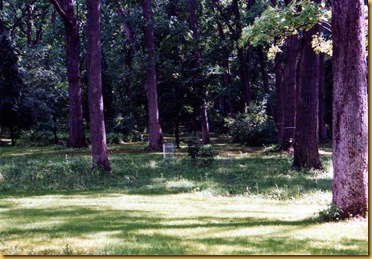
The oaks, Quercus alba, were some of the largest and tallest in the county. I remember marveling at the way the most distal sprigs of leaves filled in the canopy like perfectly fitted jigsaw puzzle pieces with no overlap so as to maximize space and minimize competition. Each little solar collector leaf got its share in the distribution of light.
 
Woodsy Domicile 6 Crane Rd Backyard
 
Managing what amounted to a woodlot couldn’t have been considered more than mere “forest gardening.” What I had wanted was simply to let the lot with its native species return to a state of balance, based on the principles that had led me to this little Forest of Eden in the first place. That sounds easy, but it wasn’t. Previous owners had put in lawn grass where the forest floor once supported a diverse mix of herbs, shrubs, moss, and lichen. They had used the old tractor mower left in the shed to scoop up and haul off the autumn leaves to huge rotting piles along the edge of the property. Some of the huge 150 year old oak trees were chlorotic, exhibiting a sickly pale green color in their leaves, due to the absence of necessary nutrients that were supposed to have been made available by the annual leaf fall. Who knows what pesticides and herbicides they used to maintain the monoculture of grass at the cost of a mix of interacting ground cover plants, insects, nematode roundworms, fungi, and microorganisms, which tend to more efficiently utilize and move nutrients through their cycles? Where there wasn’t grass were thickets of exotic, invasive weedy species. It was going to take a lot of work giving the wood lot back its more natural and self-sustaining properties.
 
Dry well
 
And that work couldn’t even start until a more fundamental problem got solved: what to do with storm water. During the nineteen nineties, the area experienced a five hundred year storm that dumped seventeen inches of rain in twenty four hours. Taking my cue from storm water management policies and procedures, which had bubbled prominently to the surface in local building codes, and had become a foundation piece in the high school science curriculum list of topics, I got a chance to model a miniature version of a municipal storm water abatement system on the lot.
 
strormwater sewer & dry well
 
Storm water pooled along the front of the long, ranch-style house and leaked terribly through a basement window, which had been sloppily bricked in to make way for a bay window sometime in the past. With a pick axe, a shovel, and a wheelbarrow, I dug out thirty cubic yards of clay soil and fashioned a drain tile channel that led to an eight foot deep dry well filled with septic stone. It took all summer and, by means of brute muscle and bone, taught a personal lesson that served to ratify that critical piece of the freshman science curriculum.
 
Tutored in botany and forest ecology, I had to marvel at how foreign-evolved buckthorn, Rhamnus cathartica, an understory shrub, dominated in the absence of competition under the oaks. First to leaf out in the spring and last to drop leaves in the fall, they common-buckthorn-foresthogged the filtered sunlight and living space, and prevented the natives from growing. In a fit of disdain, I dug up the buckthorn by their roots and dragged them all into brush pile after brush pile for burning. I used the same tractor set up to haul back the inadvertently composted, and thus organically rich, leaf litter, piling it onto the grass underneath the oak trees. I felt sadistic glee in smothering the grass while enriching the oaks with their long lost source of recycling nutrients. I drilled holes with an auger over their shallow roots systems into which I poured sulfur that would lower the pH to natural levels so that soil micelles would no longer imprison necessary iron.
 
garlic_mustardI waited impatiently until the biannual garlic mustard, Alliaria petiolata, another invader from Eurasia, was in full bloom and then, in another fit of righteous indignation, either decapitated them of their flower tops with a weed whacker or laboriously yanked them up by their roots and bagged them until they suffocated to death. (Without bagging, the hardy little suckers would continue to grow and seed by the thousands, even though their lifestyle had been mercilessly reduced to laying in uprooted piles.)

Prescribed burn

County ordinances allowed open fires, so I applied carefully prescribed burns to keep weedy grasses and shrubs from becoming too dense. I hoped also to eliminate the seed bank of invasive species in the soil with its many years of accumulated annual deposits.

Oaks are mid-successional forest dwellers, dominant during the middle age of eastern deciduous woodlands. Their foliage is highly transparent to light. Such woods have high biodiversity. If allowed to mature in the absence of fire, these woodlands would fill with “climax community” species, including shade-tolerant maple. Only a few kinds of plants besides the maple themselves can thrive under these deep shadow-casting trees, so the biodiversity index is lower. Forest preserve enthusiasts rather prefer the bright, open, “park-like” effect that is maintained by prescribed burns under the more transparent oaks. The greater biodiversity that incoming sunlight supports in these communities enhances stability in the face of disturbances. In the case of drought, for instance, there will always be drought-resistant types to carry on. And if some critters were to be lost to species-specific predators, a myriad of other species would remain to maintain the efficient flow of energy and cycling of nutrients.

Wire cagesWithout fire to clear away the competition, especially for light, oak seedlings don’t stand a chance. So like an expectant daddy, I welcomed little oak seedlings found sprouting in the understory and, in a spirit of doting parental investment, weeded around them and devised a caging system made out of chicken wire and chain link fence stretcher rods, available at Home Depot, to keep the deer from browsing them for brunch.

Woodsy Domicile 9 Crane Rd Backyard
Oaks periodically “mast,” producing an overabundance of acorns. The adaptive advantage of this expensive behavior is that it overwhelms hungry squirrels and other predators. It also helps edge out the other sprouting plant competition. I remember falling acorns bonking the car top and roof all night long one autumn. The crop of plump, green orbs, after a winter of “scarification” by winter cold, a necessary step in the seed preparation process, resulted in hundreds of new born babies. I gave up the caging intervention strategy to let nature take its toll.

blackburnianwarblerAlso intending on successful rearing of new born babies were the dainty warbler commuters during the annual spring migration from Costa Rica and South American to their breeding grounds in Michigan and Canada. I remember chasing frantically with binoculars after a nervous little Blackburnian warbler, resplendent in his breeding plumage, as he desultorily zig-zagged from tree to tree all around the yard searching for insects with which to recharge his batteries before resuming the nocturnal flight north.

Shooting stars
I did feel successful in gaining ground in the struggle to return the lot to a more primeval ecological state. Though it was part of an island of woods in an increasingly fragmented landscape, native forbs, such as shooting star, true Solomon’s seal, and Jack-in-the pulpit, much to my delight, began to make their appearance in the redeemed groundcover community.
 
Solomon's seal
As the lot recouped its losses, becoming more diverse in native species, it slowly began to showcase the twin concepts of greater efficiency in natural resource use and greater stability in the face of environmental disturbances that I struggled to teach students in my life science classes.
 
Jack in Pulpit 1
Still, I knew those giant old oaks were relics left over from a past governed by processes that maintained the forest system in a steady state of dynamic equilibrium untrammeled by human interference. In the back of my mind I sensed that this oak woodland replacing itself was wishful thinking, and I grieved whenever a big oak succumbed to the larva of beetles tunneling their way through its pulsing cambium layer, the life support tissue just underneath the bark. I also worried if and when the aggressively invasive gypsy moth might finally arrive to munch the food-making leaves of the remaining trees until they starved to death. Then the dramatic oak woodland would be gone. But I can say I enjoyed many moments when “all seemed quiet” on the ecological front, even though I knew that the goal of a post-glacial and pre-Columbian era-like Eden was, at best, an elusive one.
 
Woodsy Domicile 8 Crane Rd Front Yard Bird feeder in front yard
 
Circumstances necessitated eventually leaving this oak forest idyll and moving into the city, but I will always remember how living in that “woodsy domicile'” allowed, for a time, a real sense of respect and mutual aid in my cohabitation with these interesting forest friends.

Monday, March 7, 2011

Ringered in the Polish Triangle of Chicago

20090420225118_461

March 7, 2011

School’s out. It’s Casmir Pulaski holiday, the fourth in my tenure as a teacher in the city of Chicago. It was never celebrated when I taught in the western suburbs, so I decided to pay attention, knowing how important the day must be to the largest population of Poles in the world outside of Warsaw. Should be to the entire state, because the day is backed by Illinois law.

PUBLIC ACT 80-621. ILLINOIS STATE GOVERNMENT. BIRTHDAY OF CASIMIR PULASKI--FIRST MONDAY IN MARCH--HOLIDAY. Be it enacted by the People of the State of Illinois, represented in the General Assembly :

Section 1. The first Monday in March of each year is a holiday to be observed throughout the State and to be known as the birthday of Casimir Pulaski.

Within 10 days prior to the first Monday in March of each year the Governor shall issue a proclamation announcing the holiday and designating the official events which shall be held in honor of the memory of Casimir Pulaski and his contribution to American independence.

Passed in the General Assembly June 20, 1977 and approved September 13, 1977.

Americans often prefix their identity with their ethnicity, such as African American, Hispanic or Latino American, Native American, Asian American, and so forth, and in huge cities like Chicago, there is anything but a melting pot. Such is true in the Noble Square District, crisscrossed to form a one-block triangle at its center by Division Street, Milwaukee Avenue, and Ashland Avenue, the Polish Triangle, home to Chicago’s large Polish American community. Many here, I am sure, are proud to be Americans.

PulaskiBW

So was Casimir Pulaski, who is giving me my day off. Pulaski was born March 4th, 1747 in Warka, Poland. He became a national hero in 1771 when cavalry forces he led defeated the Russians in Czestochwa. Pulaski was wrongly accused in a plot to capture and kill the King, was arrested, and condemned to death for his part in the revolt.

Pulaski managed to escape, and made his way to Paris, where he heard of the British colonialist’s struggle to break free from England. Knowing he could never return to Poland, he sought out Benjamin Franklin in Paris to ask if he would consider hiring him to fight against the British. After hearing of his reputation, Franklin recommended him to General Washington. So the proud Polish patriot of an aristocratic lineage became a proud American patriot. In a letter to Washington, he wrote, "I came here, where freedom is being defended, to serve it, and to live or die for it..."

Washington knew that the colonists had no trained cavalry, so in September 1777, he convinced Congress to give Pulaski temporary command of the small, new cavalry detachment. On the same day Pulaski pushed back the British at the Battle of Brandywine. The next day he prevented a surprise attack at an area called Warren's Tavern. Congress acknowledged Pulaski's leadership and commissioned him Brigadier General. He was given command of four cavalry regiments.

225px-Kazimierz_Pułaski

During the winter at Valley Forge in 1777-78, Pulaski wanted to train the cavalry properly, but was instructed by Congress to rest his men during the winter, as was customary at the time. Later in 1778, Pulaski became frustrated that his cavalry had not been involved in any important battles. Considering resignation, he asked Washington to allow him to start his own legion. He offered to recruit men, outfit them, and train them his own way. He would prepare this cavalry for active duty. After many letters from Pulaski, Congress finally agreed. With 68 horses and 200 foot soldiers, the Pulaski Legion would become the colonists' first true fully-trained cavalry.

During a battle in Savannah, Georgia, Pulaski was wounded by a cannon. He died from complications of this wound, an American hero.

690 CV B4 4.50 Cleveland $2.25 690 CV B4 4.50 Gary, IN $2.20 690 CV B4 4.50 Milwaukee $5.35 690 CV B4 4.50 Toledo $8.40 690 P-3D Roessler Savannah, GA CV26 x 2 $11.50 690 CV B4 2.00 WA DC $4.50I can’t think of a better way to spend the holiday that celebrates a Polish American hero than catching a little background to help illustrate my attempt to complete the collection of plate number block first day covers with the Pulaski stamp, commissioned by the U.S Postal Service to recognize the birthday of the Polish patriot of the American Revolution 150 years following his death. So far, I’ve found five of this type of cover out of twelve cities in which the 2-cent commemorative postage stamp was sold on its first day of issue, January 16, 1931. Why so many cities? They had substantial populations of Polish Americans living in them. The general is modeled from a portrait in Jones's History of Georgia, printed from an etching by H. B. Hall. Behind the vignette are U.S. and Polish flags.

Podhalanka

More significant to me, however, is what happened about a month ago. An artist friend from Cincinnati came up to take part in a gallery opening that featured her work. Staying with friends living in the Polish quarter, she invited me to eat at Podhalanka’s. You might miss this unassuming Polish mom-and-pop diner if walking by. But it sits on the south side of Division, a few feet east of Ashland, and half a block west of Milwaukee. In other words, it’s smack dab within the one-block Polish Triangle.

Matka Boska Gromniczna

I got there early, and a gray-haired lady gestured to me to sit anywhere. I sat looking at the fake brick paneling and waited for my friend. The place looked like we were going to eat breakfast in a church basement or an American Legion hall. Of course there were pictures of the Pope and huge Polish and American flags. There was also a Matka Boska Gromniczna, Our Lady of “The Blessed Thunder Candle,” and plastic flowers. It was January, but Christmas lights adorned little plastic trees in the window. Once there, my friends said this was THE place for homemade polish cuisine.

Podhalanka inside

The Polish mom bid me to pick up menus on the long counter. I practically expected her to be wearing fuzzy pink slippers. I ordered pierogi (Polish dumplings). My friend ordered sour borscht soup. Her artist friend ordered something made of cabbage. Then came a plate of potato pancakes with sour cream and applesauce. What I initially thought was a plain glass of water was a sweet drink called compote. The potato pancakes were perfectly crisped while not being too full of oil. But it was heavy food. I learned that the Poles have perfected a menu that feeds Slavic peasants, the basic ingredients which consist of pork, dough, potatoes, beets, and cabbage. Someone wrote the following Haiku to describe it.

Plump, buttery lumps

Smelling of onions and dough

You make me so fat

Her friend suggested that after breakfast we stop in to see the local Polish Roman Catholic Church, Saint Stanislaus Kostka, a grand neo-Gothic structure built in 1890. The chatter on the way was friendly and informal. We arched our necks to view its high tower of traditional masonry. The doors had their original, peeling paint. The interior was rich in old world grandeur. The sacristy was resplendent with silver and gold detail. And adorning the entire wall to the left of the alter was Our Lady of Guadalupe, quite a gesture to a tradition indigenous to the natives of Mexico who have assimilated the Spanish Catholic traditions into their own according to the experiences of a faith fashioned far away from Europe.

may_23__2010___016

What happened next shook me to the bottom of my very sort of refurbished Catholic soul. And recounting it now is just as poignant to me. You see, my friend lost her sweet, kind, gentle, happy, thirteen year old daughter to the brutal sexual attack of a mass murderer. It happened March 7, 2009, exactly two years ago today. He is now on death row, and the family continues to heal. There has been an outpouring of sympathy, of course, and many memorials. My grieving friend said once that she is now a new kind of mother. "It is healing to have a sense of mission in life. I'm her mom in a different way. I feel like I'm carrying on her legacy now." And I have offered since meeting my friend any help I can to aid the healing process. My friend and I sat in a pew for awhile looking around.

“Look, Our Lady of Guadalupe.”

“Yes, Madonna and Child.”

“I have no child.”

“You have a child, and you are managing her legacy.”

We sat a few moments longer in silence before finally leaving the church.

2008-12-5

It is fitting that today commemorates a Polish American hero so soon after a visit to the heart of the Polish community, the Polish Triangle, in a city that most certainly celebrates him. Because it is also a day during which many are commemorating the two year anniversary of the leave-taking of Esme Louise Kenney, the daughter of my friend. Esme too is a hero. It is my belief that through her incredible spirit she brought a serial killer to justice, and thus saves future lives. (See Strength Made Perfect in Weakness.) It is my hope and prayer that these many are also receiving inspiration and grace today like I am, and like I did in that Polish Catholic Church that day, from the sainted soul strength of this remarkable child.

Sunday, March 6, 2011

Holding Ground in the Tar Heel State

I thought I could make some money selling the stamps I collected as a kid when the American Philatelic Society National Exhibition came to Chicago in 2006. I just knew my American and British Colonial stamps that had been safely tucked away in wax envelopes for years had appreciated in value. They hadn’t. What appreciated on the spot at the exhibit was my rekindled interest in collecting stamps again.


First Day Cover of Scott 797 with hand- colored cachet by Torkel Gundel

Sticking out of the stamps I failed to sell was a canceled souvenir sheet with a facsimile of the 1934 National Parks ten cent issue, reprinted to celebrate the Society’s convention held in Asheville, NC in 1937. Staring at the vignette of Smoky Mountain National Park brought to mind life and times in the Tar Heel State of North Carolina.

First Day Cover of Scott 765 with hand- made cachet by Georges Laffert

The handmade map by Georges Laffert on my rare first day cover of the Smoky Mountains stamps, part of the Farley imperforate National Parks special printing of 1935, provides me with a visual cue for my wanderings around the state. North Carolina gets its nickname from those resistance fighters during the Revolutionary War who held their ground, aided by tar and pitch from the state’s expansive pine forests that they applied to their heels. The rich diversity of geographical landscapes is well worth defending. They include the coastal Outer Banks and their barrier islands, eastern Gulf Coastal Plain, central Piedmont Plateau, and western Appalachian Mountains.

Ocracoke

The summer I graduated from a high school in Norfolk, Virginia, my brother and I went car camping on Cape Hatteras National Seashore. This landscape spends half its time in the air. Picket fences strung along the barrier islands to control the wind-blown sand still can’t keep meandering dunes from burying telephone poles up to their necks. Grit in our camp meals testified to winds believed to have ship- wrecked many a Spanish fleet off the coast. The light beam that pours out of the second oldest lighthouse in the U.S. on Ocracoke Island has to be as yellow as Spanish doubloons that still lie spilled all over the continental shelf.

Smokies June #2 Michael Mancil

A freshly minted college graduate, I returned to the state explicitly to backpack the Smokies on my way to Florida to visit my brother, then a lieutenant in the Navy, stationed in Jacksonville. It was June, and the summer rains were Smokies June Michael Mancilpumping trillions of fresh green plant cells plump with osmotic pressure. My degree in botany made the climb through numerous ecological zones to the summits a taxonomic thrill ride, because countless plant species had been cornered here by the last ice age’s walls of advancing glaciers. The biodiversity index is off the charts, and every ten paces required stopping to marvel with my ten-power lens at some new, exotic inflorescence.

Nicholas Menard httpred-dragon-goodness.deviantart.comartFirefly-Forest-82096168 N Menard http://red-dragon-goodness.deviantart.comartFirefly-Forest-82096168

The night before ascending the green-cloaked hills I was enchanted outside my tent by a silent, blinking Disney dance of dainty dervishes. This Tinker Bell firefly display sent my mind into a rhapsody that hopelessly distracted me from my reading Kierkegaard’s Stages on Life’s Way in the light of my Hope candle lantern.

Eckerd weather- proofed camp tent

The Eckerd Foundation of Clearwater, FL hired me to counsel kids with emotional difficulties in special therapeutic wilderness camps, and I jumped at the opportunity six months later to help open new ones in North Carolina. The first, near Hendersonville below the Smokies, opened in the dead of winter. Since I was slated to help prepare the next one near Candor in the Piedmont, I wasn’t put into a therapy group; rather was sent on errands such as driving a Kubota tractor down to Candor and returning with supplies.

Time off when your residence is your workplace and your room and board is your primary pay can be challenging in winter. An $8 room with a water heater the size of a pumpkin limited one weekend’s relaxation to an episode of the Donnie and Marie Show, accompanied by pretzels and a quart bottle of beer. Finding college campuses more affordable and more interesting places to crash, I got out of my sleeping bag in the snowy Warren Wilson chapelgraveyard behind the chapel at Warren Wilson College near Asheville one Sunday morning and wandered into the service. Students were leading the liturgy, and an absolutely gorgeous girl gave the sermon. Using the need to patch my backpack where a squirrel had gnawed a hole in the side, I set up a repair service next to the table in the student lounge where I found her later with friends. The gnarly guy with the adventure stories and romantic employment eventually got the girl, well, almost. Her romance with another student was a nuisance, but for the next year and a half, she put me up in her apartment on time off days in exchange for serving as court raconteur, regaling her with tales from the outback.

Eckerd camper recreating his sleeping tent E- Ma- Etu

I felt bad for those kid’s first taste of camp life, waking up in their hand-made tents in frigid subzero chill. We were trained to recognize, however, how much kids cared for their tents, which they never vandalized, because they built them themselves, learning basic math and writing according to the curriculum that lay subversively hidden behind the need to get the job done. Had they been told they “were in school,” they would not have been so cooperative. I felt quite proud of one made by Chimptas, one of my therapy groups, that was pentagon in shape, a first in Eckerd history. I heard that it confused the canvas cutter and sewer back in Clearwater due to the irregular specifications.

plant-Nettle-Stinging

First order of business when the Candor camp opened that spring was getting the new campers out into their first month-long canoe trip. We chose the Haw River to put in, which fuses with the Cape Fear, the primary drainage channel into the Atlantic of that portion of the Piedmont Plateau. Kids lugged canoes and gear over an eighty foot-high coffer dam of strewn boulders, tumpted canoes in rapids, pitched tents in stinging nettle, and ate cold dinner out of cans due to spending twilight singing sleeping bags to get them dry in the campfire’s heat. Alleged therapeutic benefits justified the serial sets of ordeals. Then a severe spring storm blew in. The torrential downpour pelted our lean-to’s on an island all night long. In the first light we saw only the tips of the canoes jutting out of the water like miniature ice burgs, made vertical by their moorings twenty feet below the rising water. I stripped nude and, like a burlesque pirate with a buck knife blade in my teeth, dove down to cut the lines. The river was rising fast. Yanking everything in the campsite and dumping it into the canoes, we made it to high ground, where we waited days for the flood waters to recede.

standing wave 2

Weeks later back in camp, stories after the chuck wagon meal lived up to their tall tail trappings. A roly poly eleven-year-old, infamous for running away from programs previous to ours by hot-wiring cars and making his get away while eying the road through the steering wheel, proudly recounted his group’s rescue off their river. They had hit five-foot standing waves after the storm, and all canoes tumpted. His pinned him to a tree, and no amount of yanking could dislodge it. Being years before cell phones, a counselor had to hitch to town to alert the sheriff’s department, who failed also in their attempt. The river was rising, and the other counselor, hospitalized later for acute hypothermia, was having trouble keeping the kid positioned so as not to drown. Finally a helicopter from the 82nd Airborne Division in Fort Bragg was called in to wrench the canoe free. The pudgy camper, insulated from the cold like a harp seal, was no worse for the wear.

NC Tobacco

Trips from the scooped out creek beds of E-Ku-Summee’s pine- wooded 800 acres in the rolling Piedmont to the UNC campus at Chapel Hill for furloughs took me through the heart of Tobacco Road. Every stage in tobacco’s labor-intensive growing season was visible at some point. I’d see migrant workers topping shucks, ridding them of suckers and pests, pulling their leaves, or binding them to hang in open-sided barns for curing. Chapel Hill was a major stop during my years as a college town crasher. I tried to pick up girls in cafes along Franklin Street, such as the Carolina Cafe, while looking the part of a Southern Ivy League intellectual. I’d be reading Chaim Potok’s novels about young Jews coming of age in modern society, or else investigations of sudden personality change in the then epidemic of religious cults, or especially Kierkegaard, and I would strike up conversations with them. Then I would offer to buy them a beer at Spanky’s. On the road back to camp, I’d make it as far as Chatham Mill’s embroidered patch factory in Pittsboro, once being let in to marvel at the intricate machinery needed to weave them. Before it closed in 1996, it was the largest producer of woven labels in the world. I would crash in my little Fiat with the driver’s seat flattened, with just enough time the next morning to relieve my fellow counselor so he could take his leave for a day and a half.

Lake Murray SC

There would be further adventures on the trail and river with those kids before leaving the Tar Heel State. One trip took us down the Savannah River for a month in a makeshift raft, the Yellow Submarine. Another trip got us on huge Lake Murray behind the the 1.5 mile-long Saluda Dam in South Carolina, which was an engineering feat in its day. The dam, using the native red clay soil and bedrock, was the largest earthen dam in the world when it was completed in 1930. The lake behind was once the world's largest man-made reservoir. I must recount one critical decision I made one windy day in our canoes along the southern shoreline. The gale-force winds were blowing from the south, threatening to side swamp the canoes unless we did something. So at a critical point in camp time, I signaled to the other two canoes to head downwind north, which would send us zipping with the wind across the fourteen miles of the lake. I was breaking in a new counselor at the time, who sat cargo in a canoe. Devout, he was reading the Bible, probably the passage in which the disciples are entreating their Master to calm the winds over the Sea of Galilee. Surfing the whiteheads, we made the opposite shore in record time.

In camp, the primary order of business was tent building. Each group site required four sleeping tents, Chief's sleeping tent, chuck wagon large enough for ten campers plus chiefs to sit around a center table, tool tent, and latrine.

The time frame for constructing a complete set was about eighteen months, the average stay of a camper. Then tents would, one-by-one, be torn down and rebuilt. Each camper thus participated in a complete cycle of camp building.

Smokies January 1 AR RamblingsI had earned the $1,500 stipend for sticking with Eckerd for at least two years by an August, but stayed on for awhile longer as the counselor for the transition group of camper graduates close to being discharged, who spent time in a camp learning resource center and at home with their families on weekends. It was November. The leaves were falling. My exit from the Tar Heel State was, again, by way of the Smoky Mountains. I had no idea what to do next with my life. A week solo in the mountains would be a retreat to gather clues.

Smokies 1979

Smokies January 1 #3 AR Ramblings

Smolies November 12 Michael MancilI met no one else on the trail. I had the Smokies all to myself. I needed them. You see, there was this girl in Urbana, Illinois I had been chasing for three years. I had been just smitten with her. Unsure of my future and of her, I braced myself against the winds and huddled over campfires in the empty huts on the Appalachian Trail. I felt the solitude of a lone black bear rustling in the fallen leaves for food. A storm pelted me in a flimsy Kaarenplastic tube tent. I stripped to ford a raging stream, swollen from the all night rain, pack held high over my head. I had to test my resolve one last time regarding her, but lingered in the mountains, not wanting to give ground in the Tar Heel State. My heart had been shaken to its foundations once before with her, and the years on the road had been, in part, a response to that experience. My odyssey had been in her name. With my letters to her recounting my adventures, I had wanted to impress her. Like Odysseus, I wanted her to be my Penelope, to whom I would come home to drive away the suitors. It was times like those when I learned that I wasn’t truly the master of my fate, the marcher to my own drum. The silence of those Smoky Mountain miles told me I had bidden her to share in molding my fate. Unbeknown to her, she was.

My Scott 749 Plate Block with Selvage Number

Smokies Michael Mancil 
Smoky Mountains by Michael Mancil manifesting accurately the vignette of the 1934 commemorative 10 cent postage stamp


My Scott 765 set of arrow blocks from an uncut Farley sheet
 
Earn a degree at the online degree website.